

Since the beginning of time, women have had breasts — however, we didn’t always have the innovations that are available today to support them. Today, there is a wide range of bras to choose from, varying in style, functionality and fit, but that wasn’t always the case. So, how has the brassiere evolved over time, and what major inventions had an impact on women’s bustlines everywhere?
Read on for a historical timeline of one of our most cherished undergarments.
14th Century B.C.: While it’s difficult to determine precisely when the first bra was invented, it’s believed to have originated in ancient Greece. Wall paintings in Crete display female athletes with a strip of linen or wool wrapped around their breasts, tying or pinning it in the back. They wore this piece, which looked something like a bandeau bikini top, during competitions. In ancient Rome, mosaics also wore these bands, which are referred to as “mamillares,” while performing dance or gymnastic routines.

1500s: Décolletage was very much in vogue during the Renaissance, hence the emergence of the corset. It didn’t take long for them to become essentially mandatory to wear, particularly among the upper class. Corsets are said to have been popularized by Catherine de Medici, Queen of France, who required that the women of her court maintain very small waists. Corsets remained in style for another 400 years.
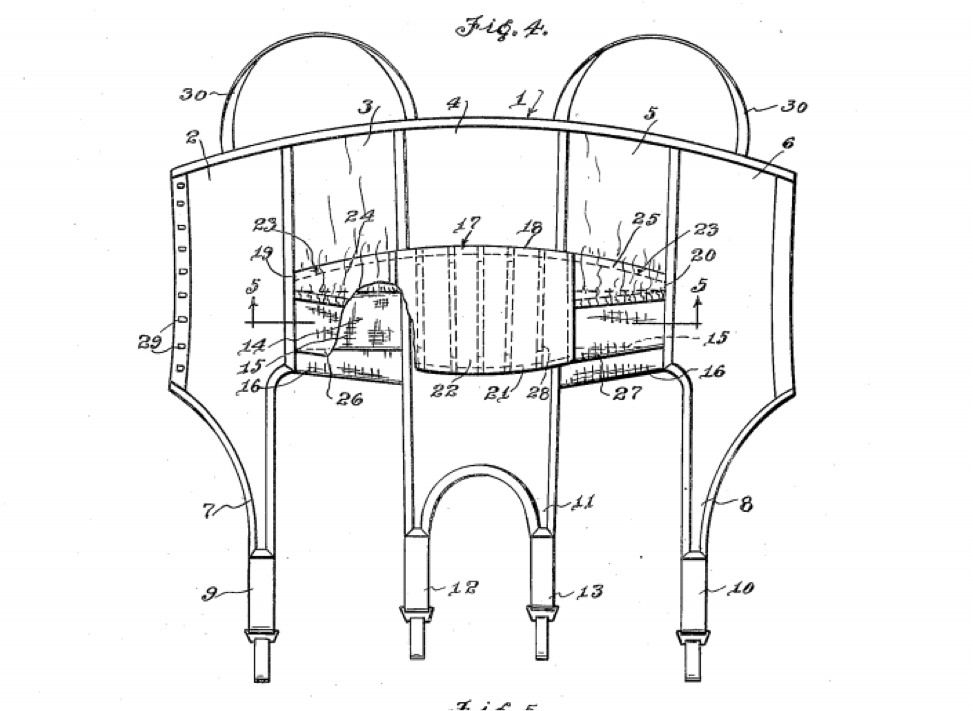
1893: Marie Tucek invents a garment that has shoulder straps, a hook-and-eye closure and a supportive metal plate with two separate pockets for each breast above it — a precursor to the underwire bra — and receives a U.S. patent for her design.
1910: A Manhattan debutante getting ready for a ball noticed that her corset poked through her sheer evening gown, so with some help, she constructed a far less constricting one with only silk handkerchiefs and ribbon, leaving out the whalebone. The other socialites couldn’t stop buzzing about her invention and how it allowed her to dance more freely, and soon were paying her to make more of them. The socialite, Caresse Crosby, was granted a U.S. patent for her invention of the “Backless Brassiere” in 1914. Eventually, she sold her patent for this lightweight garment that naturally separated the breasts to CT-based Warner Brothers Corset Co. for $1,500.
“I can’t say that the brassiere will ever take as great a place in history as the steamboat,” she wrote in her memoir The Passionate Years, “but I did invent it.”
1911: The word “brassiere” is finally added to The Oxford English Dictionary after the term was used in Vogue magazine. Fun fact: the French word had been used for centuries to describe a soldier’s arm guard or shield (it derives from bras, meaning arm) as well as a military breast plate.

1920s: The curve-free flapper silhouette means corsets (which enhance an hourglass shape) are traded for bandeau tops that flatten the breasts (making those fringy dresses hang straighter). Initially, these bras were one-size-fits-all, but by the end of the decade, the letter system for cup size had been developed.
1930s: Bras (now commonly shortened to this abbreviation from brassiere) make some major headway with a multitude of innovations, including adjustable straps and padded cups. Glamorise receives a patent in 1932 for a brassiere with “resilient means to keep the shape of the body in proper form.”
1943: Just in time for the baby boom, the first patent for a “nursing brassiere” is granted to inventor Albert A. Glasser. This garment was designed to offer extra support to women in the midst of lactating. The cups featured flaps that could be opened, allowing for comfortable breastfeeding without needing to remove the bra.
1950s: During World War II, pin-up girls popularize the look of the “bullet” bra under their angora cardigan sweaters. Meanwhile, young women entering puberty start sporting training bras as their breasts develop.
In 1951, Glamorise’s ADJUST-EZE girdle was featured in a LIFE magazine print ad — the patented design offered an adjustable waistline.
The introduction of stretchy spandex in 1959 means more comfortable and better-fitting bras.
1960s: Major updates are made to the mastectomy bra, which now featured separate stretch pockets to allow a prosthesis to be inserted and covered. In 1964, Louise Poirier crafts the first bra specifically designed to give breasts a lift (essentially a push-up bra), known as the Wonderbra, for Canadelle.

1970: Glamorise receives a patent for its revolutionary MagicLift bra, a soft-cup (wire-free) bra that features with the unique criss-cross design to lift, define and support the breasts.
1975: Female tennis champ Chris Evert had just won the U.S. Open, and the passage of Title IX several years earlier offered more female students the opportunity to participate in athletics. It was the perfect time for Glamorise to introduce the world’s first sports bra. As the name suggests, the Tennis Bra was designed specifically for tennis players, including moisture-control cups and added supportive features.
1990: Glamorise introduces the Wonderwire bra, which boasts an invisible wire that doesn’t touch the body.